
Materials innovator Modern Synthesis shared its experience of adopting Alchemite™ machine learning at an Intellegens webinar. Time is critical, as the Modern Synthesis team race to take their novel biomaterial technology from pilot to full-scale production at manufacturing clients within a year. After just over four months working with Alchemite, Modern Synthesis already reported a 30% increase in development speed. As well as the insights and predictive capabilities offered by machine learning, a smart approach to adoption, with active support from Intellegens, has been key to the journey so far.

Modern Synthesis aims to achieve petrochemical performance using bio-based ingredients only, creating a fully bio-based resin that can be applied in multiple textile industries. Their innovative approach is based on bacterial nanocellulose and uses intricate nanostructures to impart unique properties and film-forming capabilities, resulting in novel composites and resins. These materials have demonstrated performance competitive to the petrochemical performance in the market, at very low environmental impact.
The company’s immediate goal was to go from successful pilot production to full scale manufacturing within a year. For commercial viability, the technology must work as a drop-in replacement for existing materials, meeting manufacturers’ requirements with very little flexibility. This creates a complex, multi-variate optimization problem, seeking to combine ten or more ingredients with the right processing conditions to meet a tight range of performance targets.
Over years, Modern Synthesis has tried hundreds of formulations and different mixtures. It hoped that by leveraging this data using machine learning it could unlock new formulations and achieve the desired objectives, faster. At a recent webinar, Head of Science, Ioannis Zampetakis described how his team worked with Intellegens to implement the Alchemite™ machine learning method, looking for a significant impact within six months.
Beginning with a team that was “curious but not convinced”, it was important to focus on adoption. Machine learning projects often fail not due to the models or quality of data, but because it is inherently difficult for organizations to adapt to new tools and approaches. This risk can be reduced by making well-targeted and intuitive software tools, but Intellegens also focuses on the adoption process – assigning its scientists to work closely with new adopters in the early stages. Weekly joint project meetings help users get their data into the system, identify productive routes for inquiry, and move at pace to generate valuable insights. Ioannis Zampetakis described how this process bore fruit – “The Intellegens team was very helpful. We developed a workflow together. Once we did that, we were able to demonstrate an experimental recommendation from Alchemite that went through our labs and gave us a huge step improvement in our development. Within a month, we were able to get this first unlock.”
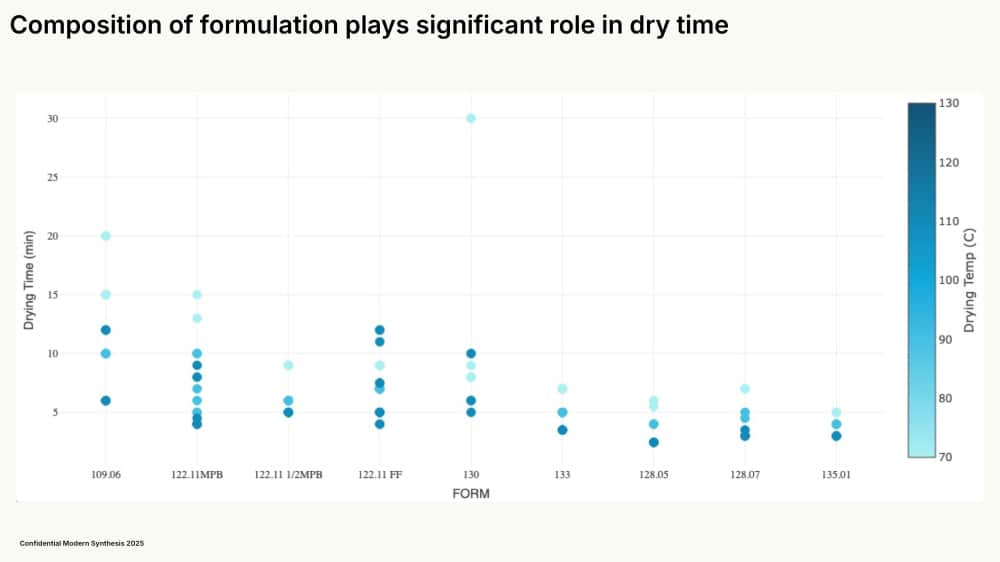
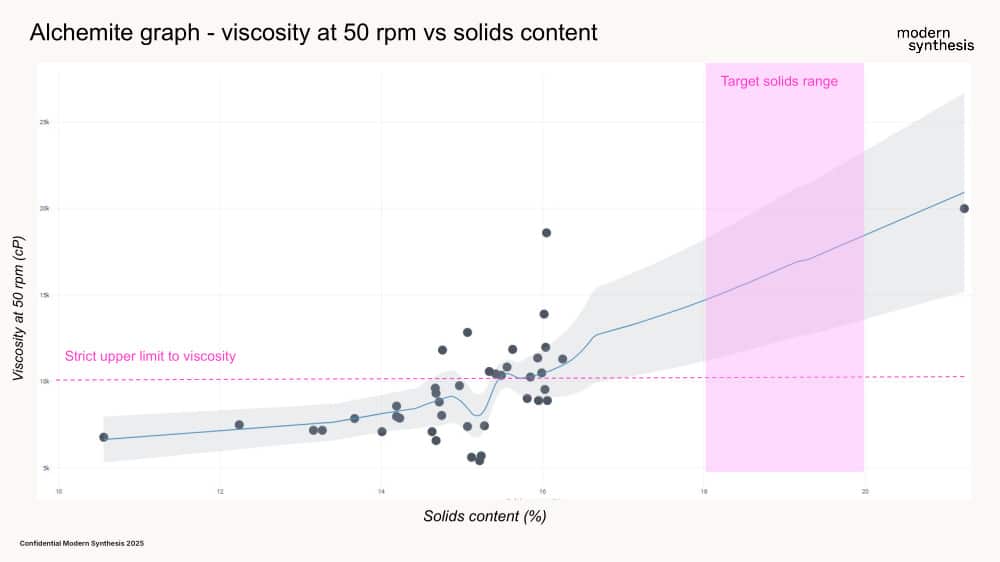
He was also able to share two examples of positive results that the project has gone on to generate. The first focused on a key metric – the combination of drying time and dry temperature for different formulations. The goal was to get the least amount of drying time, at the lowest possible dry temperature. Alchemite enabled the team to see all of their formulations in one place and assess them in multi-dimensional spaces, and to then ask the machine learning model to give recommendations for experiments that drove towards the targets. The project was able to achieve very fast drying times at very low temperatures, moving much faster to the research objectives than would otherwise have been the case.
Another key consideration was the amount of solid in the formulations and the resulting viscosity. If the product is too viscous, it won’t be able to coat. This was an area where the team was stuck initially but was able to apply the machine learning model to find formulations that achieved the target range. Ioannis Zampetakis commented “We now have formulations that we’re shipping to our external partners that have the right solids, the right viscosity, and they are able to do trials themselves directly, really accelerating the R&D.”
Successful adoption in this initial project has taken the use of Alchemite machine learning over the “activation energy” needed to make it part of the Modern Synthesis workflow. The team now uses it weekly in experimental design and is extending use across R&D – for example, into optimizing material properties such as tensile strength, Young’s modulus, flexibility, and durability and into developing the construction of the systems that employ its materials – such as composites with adhesive and top coats.
Ioannis Zampetakis concluded “we have seen a 30% increase in our speeds of development and been able to get a lot of help from using the system directly, while also we’ve been able to… get more visibility on our data and make the most use of it as we go through development. Now that the system is established, we expect these gains to increase.”


